
Peace can be tricky.
In a perfect world, the U.S. and Iran would sign a peace agreement. So would the Israelis and Palestinians.
Students at Eisenhower High tried, but Iran didn’t show at the negotiating table and Palestine’s representatives spent their hour just trying to find Israel’s people. But the U.S. representative used his time wisely, negotiating pacts with South Africa and Ghana for gold, in exchange for technology and military protection.
The interactions were part of the Model UN, an exercise created for social sciences students at Eisenhower High. Each student was assigned to represent a specific country (or, in some cases, countries, depending on how many social sciences classes they have), then spent their class hour doing things such as meeting with leaders from around the globe, negotiating treaties, getting loans from the World Bank, and negotiating issues such as new scientific inventions.
Teachers Kenneth Jones and Milissa Gryctz said Model UN was cut down to a two-day exercise because in past years, teachers found the longer it lasted, the more inclined students are to declare war (wars tend to break out all over the place in day three, Jones said).
Not that day two of this year’s exercise was without drama. In addition to Palestine being unable to find Israel to start talks, two representatives from Saudi Arabia quietly said they sold their country. They weren’t sure for how much, the two admitted sheepishly.
All in all, maybe not too much different than a typical day on the real world stage.
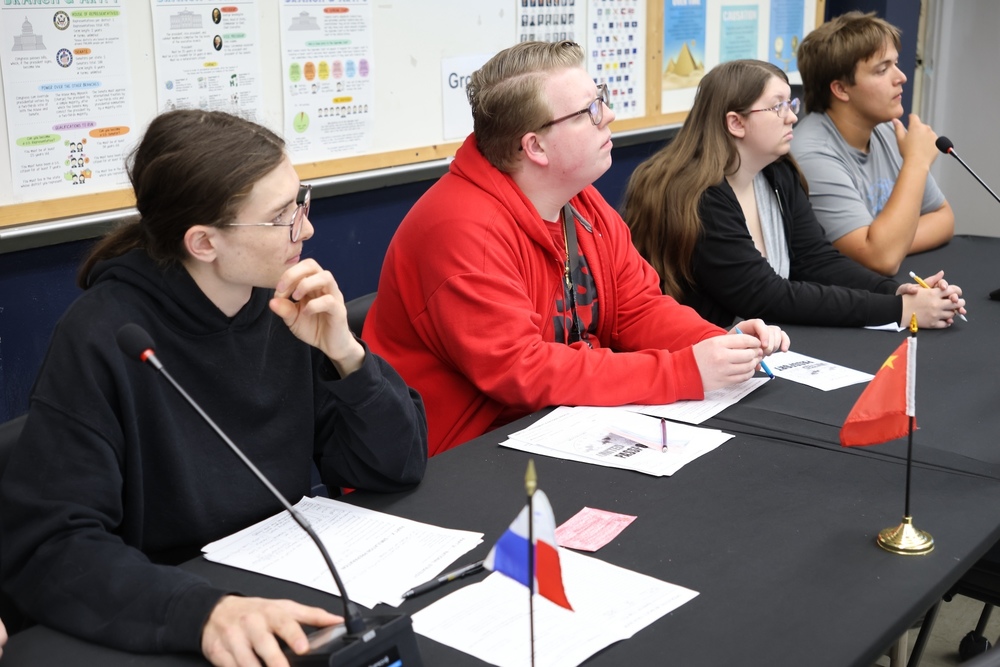
While treaties could be negotiated anywhere – social sciences classrooms were designated as countries, so it wasn’t unusual for representatives to be sitting together at a table in Africa and discussing trade deals – the hotspot was the UN Security Council. Jones was moderator there, keeping order and calling the Council into session when he could get a quorum.
“United Nations is not a debate club,” Jones told participants in one hour, as countries tried for a quorum on a question called by Russia: a treaty to end the war in Ukraine.
Jones cited the terms of the treaty the two countries had agreed to: Russia withdrawing and paying reparations to Ukraine; Ukraine agreeing to energy trades. Observers were to be sent by the UN “to make sure both sides are doing what they should.”
Alexander Jorgenson, senior, playing the Russian representative, explained Russia would keep only 15 percent of the land it took, proving to the world his people are not warmongers.
“We intend to make peace,” he said.
Ukraine’s response was terse: “Ukraine is good with peace.”
Afterward, Jorgenson broke character to explain his research for his role as Russia, adding it was important to know that despite differences, the two countries are neighbors. Still, he admitted the role was a bit of a challenge.
“It was complicated,” he said, adding he had to look beyond the differences.
While other countries at the UN supported the peace initiative, their representatives also continued their own negotiations. That included China and Great Britain, whose trade agreement particulars were under debate even before Russia and Ukraine entered the chambers. Britain offered pharmaceuticals to China; China offered technology in return.
Colston Bear, the junior playing Britain, said his country had to make the deal, explaining China is a world leader in technology, but needs the pharmaceuticals Britain can provide. He and Mason Scott, junior (China), said they had worked out the details of a strategic trade agreement; it only needed UN Security Council approval.
Jones and student teacher Braiden Warren said the negotiations were representative of the freedom given to students during the exercise. While there were broad rules to operate under, specifics were left to students.
“I’m an observer and guide,” Jones said, adding teachers try to make it as hard as possible for countries to declare war.
Warren, who operated the World Trade Bank, said his job was to oversee the countries applying for loans. Most often, they needed travel money. Each student was given $2,000 at the beginning of the exercise, which didn’t last long when it cost $1,000 to make just one trip to another country. Because the exercise required a minimum of 10 contacts, making that effort could get pricey.
It’s the poorer countries that have the most problems, Warren said.
“I don’t have enough money to do anything,” said Domino Thompson, senior, explaining why he was applying for a loan.
He and classmate Chadwick Anderson, sophomore, took Warren up on his suggestion: Go find the U.S. As a major country, the U.S. has a lot more travel money and can make loans to poorer nations, Warren said. Thompson and Anderson took off looking for the U.S.; unfortunately, they were walking in the wrong direction.
The U.S. (Travis Harrop, sophomore) was in the UN Security Council chambers, negotiating with other countries while he waited for Iran and the peace discussion they were to have. Harrop had a decided advantage if Iran showed up (they didn’t): in a previous hour, he was Iran (because he had two social sciences classes, he played two countries).
“I want to develop a treaty with Iran,” Harrop said, explaining his goal is security because nothing matters as much as “keeping the peace.”
He already had a peace plan in mind, one that would allow both sides to draw down their military and stabilize the region.
“We won’t have the problems we have now,” Harrop said.
It was a different tactic than the one he took as Iran in the previous hour, where his goal was treaties with nations such as Mexico to protect the oil reserve.
“It’s very complicated,” Harrop said, explaining his roles were different depending on the country he was portraying: Iran was cautious; the U.S. “was a little more stern and upright.”
Despite his successes, negotiations are not as easy as they sound.
While waiting for Iran, Harrop negotiated with Ghana (Randy Hoosier, junior) and South Africa (Joseph Baik, senior).
“We have gold,” Hoosier/Ghana said. “I need technology.”
Baik/South Africa said South Africa brought several resources to the table: gold, coal, platinum.
“What do you need?” he asked.
What did Ghana and South Africa want in return? Technology – and military support. Harrop was curious about what kind of power.
“Do ya’ll need boots on the ground?” he asked.
Negotiations were successfully concluded, with Hoosier taking Baik’s advice to sell only a percentage of its gold to the U.S., so they would have gold to sell to others.
Negotiations in other countries were less successful.
Palestine’s representatives had a bad day. They needed to negotiate a peace treaty with Israel, but couldn’t find that country’s people.
“Israel doesn’t want to make peace with us,” said Ashlynn Maldonado, senior, adding while representatives in the previous hour wanted peace, this hour’s people did not. She became more frantic as the hour wore on, saying “We were given a country that doesn’t exist anymore.”
Maldonado and classmate Jayda Davis, a junior, discounted a suggestion to seek out the U.S. for help, scoffing that wouldn’t work.
“Israel is the little brother,” they protested to Gryctz, of the protective stance they expected the U.S. to take.
“Go figure it out,” Gryctz said, adding that’s what would happen in the real world.
===
BOX
Eisenhower High’s Model UN project is a two-day structured geopolitical simulation designed to model how the real world operates through diplomacy, negotiation, documentation and strategic decision-making, said Charles Kirchen.
Nine teachers in Eisenhower’s social sciences department participated, with each classroom becoming a global region and each student becoming a sovereign nation. Kirchen said every major action had to be written, documented and approved, with actions mimicking what would happen in the real world – to include consequences.
Interaction between countries is mandatory; students needed a minimum of 10 contacts and had to have signatures as proof. Teacher Milissa Gryctz said contact was a major part of the exercise: “You are interacting with someone you don’t know.”
Other credit came from negotiating treaties (three for full credit). Actions equivalent to two treaties also were possible: one scientific breakthrough, a successful Security Council resolution sponsorship or an approved war outcome.
Treaties had to be specific and required discussion because students had to specify the issue or goal being addressed, then detail a plan of action that included cost and strategic consequences. Details were crucial: “if your treaty lacks realism, it will not be approved.”
The UN also played a role, with the Security Council convening to make decisions on treaties, scientific discoveries and war.