
You might not recognize the names Mary and Emily Edmonson, but the Huggins sisters do.
Did you know Floyd Norman was the first African-American to work as a long-term Disney animator? Avery Sinning can tell you all about him. And, Texas legislator Jasmine Crockett is influencing Aria Brown’s career choice even before she gets out of high school.
The Eisenhower High students were among the 25 who participated in the Living Wax Museum, one of Lawton Public Schools’ final events to mark Black Heritage Month. In this case, it was members of Eisenhower’s African American Club who selected the people they wanted to spotlight for classmates: doing the research, setting up boards with historical tidbits, and, when possible, dressing for the role.
While some names were familiar – George Washington Carver and Barbara Jordan – the majority were people the average person would not recognize. That was deliberate, said teacher Ashlie Overby, who explained his goal was to pull people from history who weren’t well-known, but who were important.
That was the thinking of Meliyah Huggins, a junior, and her sister Mariyah, a ninth grader. The two selected the Edmonson sisters: Mary and Emily.
“We’re both sisters,” Meliyah said, adding there also is the same two-year age gap between both sets of sisters.
The Edmonsons, born in the mid-1800s, escaped slavery – after a failed attempt on the schooner The Pearl and deportation to the Deep South, the sisters were helped to freedom by the congregation of Henry Ward Beecher. Meliyah said while the sisters initially were pushed into the role of “fancy girls” before winning their freedom, they ultimately became heroines in the abolitionist movement.
Although Mary (the elder) died young, Emily lived into old age, Mariyah said.
Then, there was Madam CJ Walker. While largely unknown today, she was the first black female self-made millionaire, achieved by creating a hair/cosmetics empire focused on black women.
Shaniah Moore, the ninth grader who portrayed Walker, said that was her topic’s allure: Walker created a needed product, then made money at it through her Madam CJ Walker Manufacturing Company.
“I want to educate students,” Moore said, adding she also wanted to highlight her other contributions, including support for other would-be businesswomen.
Music also played a prominent role at the wax museum, and it was a decided mix of old and new.
Among the new was MC Sha-Rock, as portrayed by T’Ella Harrison, a senior.
Born in North Carolina as Sharon Green, she moved to the Bronx as a child and began rapping, becoming the first female rapper. Harrison said MC Sha-Rock also is a strong woman.
“She was not afraid to speak her mind,” she said. “She was inspirational.”
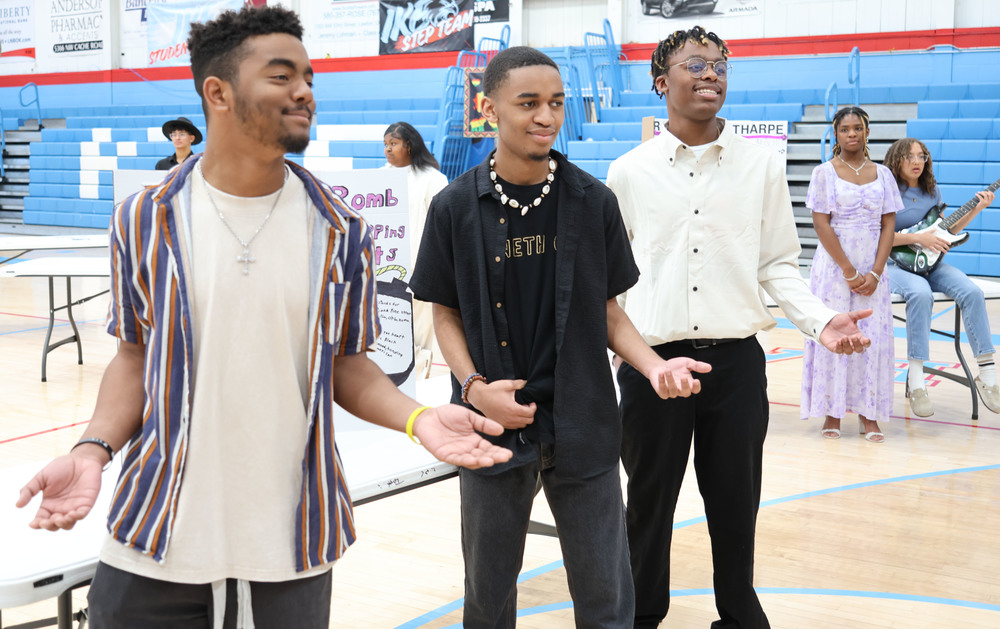
Nearby, three young men portrayed the R&B group The Gap Band, (Gap standing for Greenwood, Archer and Pine Street, from their hometown of Tulsa). The three had their presentation down to an art, standing as still as, well, wax figures until someone “hit the button” (a play button at each display) and brought them to life to introduce themselves as brothers Charlie, Ronnie and Robert Wilson.
The trio was popular and their play button was hit repeatedly, the sign that visitors wanted the three teens to tell their story again and again and again. What was the allure of The Gap Band, popular decades before today’s teens were born?
“I like their music,” one teen said.
Then, there was Aretha Franklin, the undisputed Queen of Soul. Sophomore Ivory Onna said she was eager to portray the music legend.
“She was doing what she wanted,” Onna said, adding Franklin also took that fire and poured it into civil rights. “She put her soul into it.”
Aria Brown, a junior, took on a modern-day figure: Texas Rep. Jasmine Crockett, who lost her bid for the U.S. Senate primary March 3.
“She is a role model,” Brown said, explaining Crockett taught her that if something is important, “you are going to have to go try for it.”
Overby, who sponsors the African American Club, said the students illustrated exactly what he wanted them to get out of the exercise.
“History for America involves everybody, white, black, Asian, Hispanic,” he said. “And, there is so much to history that is not tied to struggle or adversity. There were people thriving even through adversity, and making things happen – entrepreneurs and millionaires in times there shouldn’t have been entrepreneurs and millionaires.
“A lot of times, when you hear about African-American history, the focus is on slavery and civil rights. But there is so much more that African Americans have done throughout history: our contributions to the arts, to the sciences, to sports.”
Overby said while he had a list of potential figures, students could present their own ideas. If a student was passionate about an idea, he let them run with it.
“It was interesting to see the people they were passionate about,” he said.