
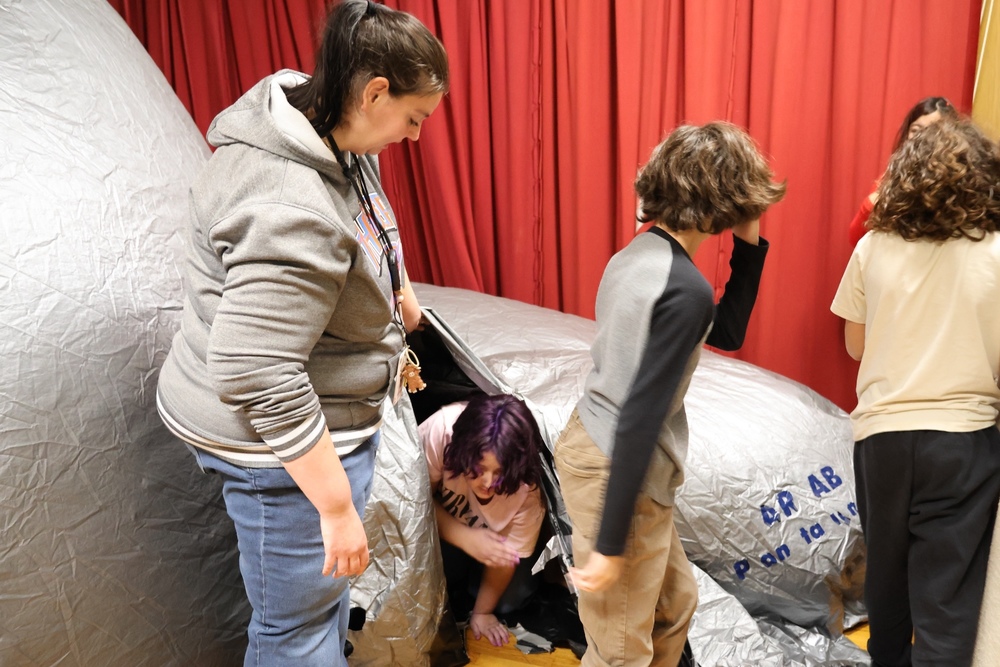
Fifth graders at Edison Elementary School are being encouraged to reach for the stars, and they recently had the opportunity to do just that when they entered the star dome/planetarium.
Doris Biegler, STEM coordinator and technology trainer for Lawton Public Schools, brought the inflatable planetarium to the school so students could have a visual experience about the stars and constellations they have been studying about for the last few weeks. Different constellations are projected on the ceiling of the dome, allowing Biegler to point them out to students.
Michelle Davila, fifth grade teacher, said she requested Biegler bring the star dome/planetarium to school so all the fifth graders could get a realistic view about the constellations.
“Living in Lawton, they don’t get to see all the stars in the night sky and most don’t have access to a telescope,” Davila said.
Davila said students have been studying the stars and their positions in the sky. Later, they will make a picture book of the different types of stars and their distance from earth.
“They are learning about the different brightness of the stars and what they mean. Just because it is teeny tiny, it could be a supernova,” Davila said.
Nathan Scovil, 10, and Presley Mitchell, 11, were two of the fifth graders who visited the star dome. Scovil said in addition to viewing the constellations, students also learned the stories behind the names of the constellations and stars.
“We learned how Medusa got her snake hair,” he said. Students also learned the importance of the North Star and how sailors of old used it as a navigation tool. “We were having such a fun time.”
Mitchell said the experience inside the star dome was “really cool” and she was able to find her zodiac sign — a Scorpio.
“I think it was fun learning about Greek mythology and finding our friends’ signs,” Mitchell said.
Davila said in addition to giving students an opportunity to see a night sky full of stars, which they may not get living in a city, it also may light the flame of curiosity.
“This helps light that flame, for even one student. They can be an astronaut or astronomer,” Davila said. “This is a hands-on experience that just might spark that flame.”